Planning
How to Get the Most Out of a Three-Day City Trip
The advice to pick one anchor a day is fine and it is not the job. The job is working out what your particular city refuses to let you do.
The short answer
- A three-day city trip is decided by one constraint that belongs to the city, and it is rarely walking distance.
- The most common constraint is a famous thing just outside the city that needs a full day the trip does not have: Sintra for Lisbon, Versailles for Paris, Ayutthaya for Bangkok.
- Three nights gives two full days and two fragments once flights are counted, so the honest ceiling is two big things across the trip, and three is optimistic.
- Name the constraint before choosing any sight, because it decides the order, and the order decides what actually fits.
- Some cities have no such constraint: Florence can be crossed on foot in under an hour, and Singapore's transit removes travel time as a planning factor.
The useful question for a three-day city trip is not how many things fit in a day. It is what this particular city refuses to let you do, because that answer decides everything after it.
Most advice stops at one anchor a day: a museum in the morning, the neighbourhood around it in the afternoon, and room to breathe. That is sound, and it is the same for every city on earth, which is why it does not help with the decision people actually get wrong. Trips fail on the thing that was never going to fit, and what that thing is changes completely between Lisbon and Rome.
A constraint here means the single fact about a city that dictates the shape of a trip. Not a preference and not a tip. Something that is true whether or not anyone planning the trip knows about it.
Every city has one constraint that decides the shape of three days, and it is rarely distance. Find it first and the plan follows. Miss it and the trip becomes the one that tried to fit Sintra.
How much time does a three-day trip actually have?
Two full days and two fragments. A flight that lands in the afternoon gives an evening, and a departure before lunch takes the last morning, so three nights buys two clean days plus the ends.
The flight-times post works that arithmetic through properly. The only part that matters here is the total it produces, because two full days is the budget every decision below is spending. Two big things, not three.
The most common constraint is the day trip that does not fit
Nearly every famous city has one famous thing just outside it that needs a whole day. On a three-day trip that day does not exist, and the attempt to squeeze it in is the single most reliable way to ruin the trip.
Lisbon has Sintra. Paris has Versailles. Bangkok has Ayutthaya. London has Greenwich, Hampton Court and Windsor, any one of which eats a day. Istanbul has the Bosphorus villages and the Princes' Islands. Tokyo has Nikko, Kamakura, Hakone and Fuji, and New York has three outer boroughs that each deserve one.
The pattern holds across the city guides on this site, because it kept turning up while they were being researched. The day trip is never the mistake on its own. The mistake is taking a day from the city to pay for it, which leaves the city half-seen and the day trip rushed.
What the constraint turns out to be, city by city
| City | The constraint | What ignoring it costs |
|---|---|---|
| Lisbon | Sintra needs a full day of its own | A rushed Sintra and a Lisbon you only half saw |
| Paris | Versailles needs a full day, and the big sights have booking windows that open at different times | The order collapses when the tickets you hold do not match the days you planned |
| Rome | Two sights each swallow half a day, on opposite banks of the river, through queues that do not connect | Both get rushed if they share a day, and both punish rushing |
| Tokyo | The city is a dozen downtowns on a loop line, and a day trip does not fit | Crossing the city five times a day, or losing a day to Nikko |
| Vienna | Three institutions run on a season, not opening hours | Arriving in July to a closed opera house |
| Dubai | Outdoor hours are set by heat for much of the year | A midday plan that is not survivable from May to September |
| Florence | No constraint. The centre crosses on foot in under an hour | Over-planning a city that does not need it |
| Singapore | No constraint. Unified transit removes travel time from the problem | Sequencing stops around journeys that take minutes |
The four kinds of constraint
Constraints fall into four groups, and knowing which one a city has tells you what to check before booking anything.
- Something outside the city. The day trip that needs a full day. The most common kind by a distance, and the easiest to plan around once it is named.
- Two anchors that cannot share a day. Rome is the clearest case: the archaeological park and the Vatican each take three to four hours, sit on opposite sides of the Tiber, and run separate queues. Give each a day or rush both.
- A calendar. Vienna is the example that catches people out, because the State Opera closes for a summer break rather than keeping shorter hours. Market days, closing days and booking windows all belong here.
- The body, or the ground. Heat in Dubai, hills and one-way escalators in Hong Kong, a climb that is worth doing once and not three times in Lisbon. These shape how a day is ordered and rarely change what is in it.
How to find your city's constraint before you plan
Ten minutes of the right questions beats an evening of collecting places. Ask these four, in this order, before choosing a single sight.
- What is the famous thing just outside this city? If there is one, decide now whether it is in or out. It cannot be a maybe, because a maybe quietly takes a day anyway.
- Which sights take more than three hours? Two of those in one day is the most common overload. Count them before anything else goes on the list.
- What is closed, and when? A weekly closing day, a summer season, a religious calendar. This is the question that turns a good plan into a locked door.
- What is the ground like? Hills, heat, water crossings, a transit network that is either excellent or absent. This sets the order within each day.
What to do with the thing that does not fit
Cut it, and say so out loud. The unspoken maybe is what does the damage, because it survives until the morning it is supposed to happen and then takes the day it was never given.
There are only three honest options. Add a fourth night and give it a proper day. Drop it and plan the city as a city. Or accept a deliberately shallow version, an afternoon in a place that deserved a day, chosen knowingly rather than discovered at 16:00 on a train.
The version that fails is the fourth one, where it stays on the list unassigned. Tokyo is the sharpest example: four separate day trips all compete for a day that does not exist, and a trip that keeps all four in play ends up doing none of them well while also crossing the city too many times.
When there is no constraint at all
Some cities simply do not have one, and planning them as though they do wastes the trip's best feature. Florence can be walked end to end, Ponte Vecchio to the Duomo to Piazzale Michelangelo and back, in under an hour, which removes the usual puzzle entirely. Nothing needs saving for its own day.
Singapore breaks it from the other direction. Its transit is unified enough and the distances short enough that travel time stops being a factor worth sequencing around.
In both cases the right move is to plan less, not more. A city with no constraint rewards a loose plan and punishes a tight one, and treating it like Rome produces a schedule that solves a problem the city does not have.
Where this approach falls down
On trips that are not one city. A route through four cities in ten days has a different problem, which is the hops between them, and naming one constraint per city does not solve it.
It also assumes a first visit. Somebody returning to Paris for the fourth time should absolutely spend all three days at Versailles and the markets if that is the trip they want. The constraint framing is for the visit where the city itself still has to be seen.
And it will not make the trip longer. Naming the constraint is how a three-day trip stops pretending to be a five-day one. That is a smaller trip on paper, done properly, which is the trade being made.
Does any tool do this for you?
Partly, and it is worth being precise about how much. Constraint-finding is research, and the tools that do research well are the city guides, the forums and the operators' own pages.
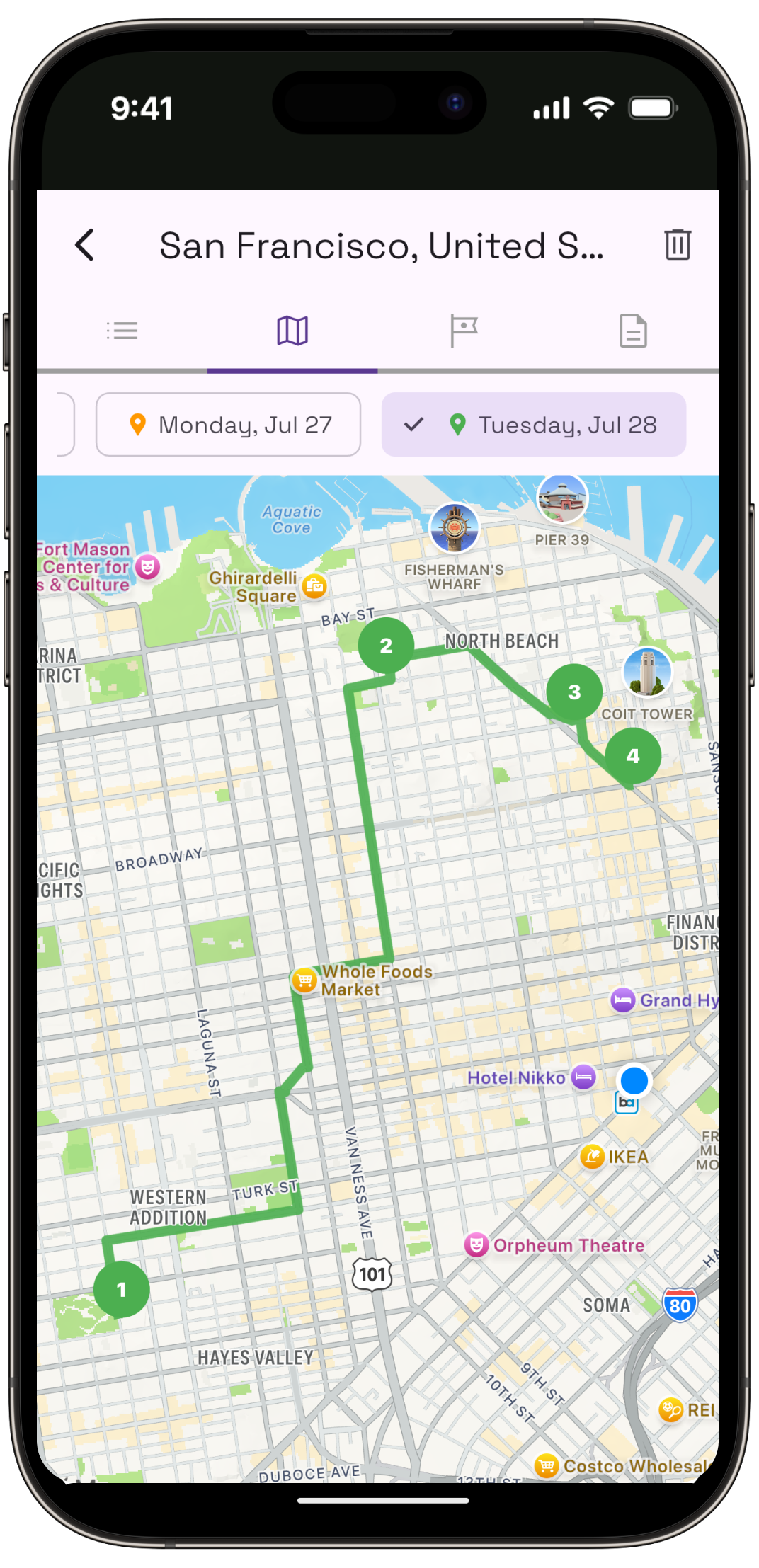
Owlio takes a city, the real arrival and departure times and a pace, then returns days with the stops grouped and numbered on a map. That handles the ordering and the sizing. It does not advertise opening-hours logic, so a weekly closing day or a summer season is still yours to check, and it plans one city per trip. The Google Maps comparison covers where the mapping tools stop, which is the same boundary from the other side.
The honest summary is that no tool currently tells you Sintra will not fit. A guide written by somebody who went does, and that is why the guides on this site open with what three days does not cover.
Common questions
How many attractions can you realistically do in a day?
Two substantial ones, plus the neighbourhood around them and food. Anything over three means rushing at least one, and the sights worth travelling for are usually the ones that punish rushing. Count anything taking more than three hours as a whole half-day on its own.
Is three days enough for a city?
Three days is enough for one city's essentials and nothing outside it. It gives two full days and two fragments once flights are counted, which covers the central sights at a sane pace but not a day trip to somewhere like Sintra or Versailles.
Should I do a day trip on a three-day city break?
Usually not on a first visit. A day trip takes one of only two full days, which leaves the city half-seen and the trip rushed at both ends. Either add a fourth night for it, or save it for a return visit and plan the city properly.
How do I decide what to cut from a short itinerary?
Cut by constraint, not by interest. Identify what the city physically will not allow in the time available, remove that first, then choose between what remains. Cutting a place you wanted is easier once it is clear the calendar never had room for it.
What is the best way to plan a two-day city trip?
The same method with less room. Two nights gives roughly one full day and two fragments, so the ceiling is one substantial sight plus the area around it. On two days the constraint matters more, because there is no second full day to absorb a mistake.
Should I plan every hour of a short trip?
No. Fix the anchors and the bookings, then leave the gaps loose. The parts worth planning are the ones with queues, tickets and closing times; the walk between them is where a trip stops feeling like a schedule and starts being worth taking.
Two full days, planned as two full days
Give Owlio the city and your real arrival and departure times, and it returns each day grouped and ordered on a map. The city guides cover what will not fit.